Problems, not people
SayGemba is designed to improve the work, not score the worker. No individual heat maps or hidden performance profiles.
You were heard. Your facilitator is reviewing the evidence request.
Illustrative product workflow
One accountable loop
SayGemba does not replace the facilitator. It removes the transcription, first-pass structuring, and follow-up friction that limits how many problems one facilitator can work.
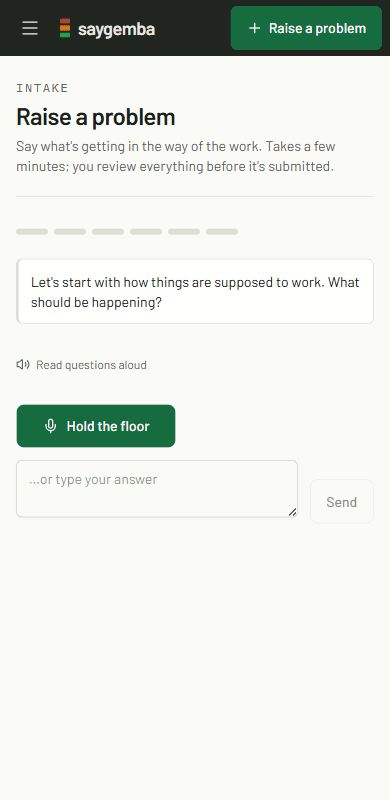
A worker explains the gap at the point of work by voice, photo, or a quick note. The interview asks what should happen, what actually happens, and what evidence exists.
SayGemba turns the account into a reviewable opportunity card: facts separated from assumptions, missing evidence identified, and confidence made explicit.
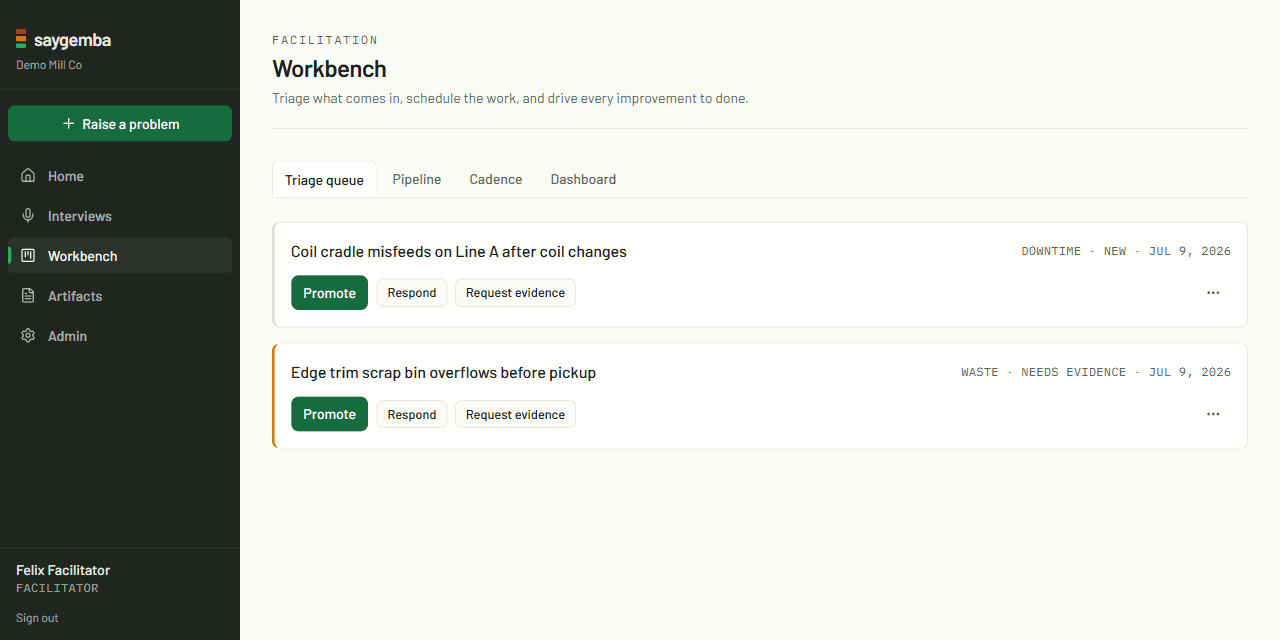
A facilitator decides what moves forward, assigns the work, runs the cadence, and records the verified result. The contributor sees what happened.
The handoff that usually breaks
The same problem moves from a phone on the floor into a controlled improvement workflow, without asking the contributor to write an A3.
Illustrative plant scenario
This example shows the workflow, not a customer result. The system keeps the target and the actual result visibly separate until a human signs off.
Signal
Frontline account: 6–8 resets per shift, concentrated in the first 2 hours.
Structured evidence
Known
142 alarm events and approximately 1,300 lost minutes last month.
Still unproven
The warm-up cycle may be skipped after specific changeovers.
Facilitator plan
Validate the warm-up sequence, assign the line owner, run one controlled countermeasure, and schedule 30/60/90-day checks.
Impact ledger
Baseline
1,300 min/mo
Target
<300 min/mo
Actual
Awaiting pilot
The 90-day frontline improvement pilot
Start narrow enough to learn quickly and prove value credibly. The pilot ends with a decision-ready impact report, not a stack of generated documents.
Days 0–14
Select one line or value stream, one measurable category such as downtime or scrap, and one accountable facilitator.
Days 15–45
Launch frontline capture, work every submission, establish response discipline, and identify the problems worth promoting.
Days 46–90
Run countermeasures, complete sustainment checks, and finish with a signed baseline-to-actual impact report.
Create the workspace for your first pilot.
Scope the line, invite the facilitator, and prepare frontline capture.
Trust is part of the workflow
SayGemba is designed to improve the work, not score the worker. No individual heat maps or hidden performance profiles.
AI asks, structures, and challenges. Facilitators and managers decide what becomes official and what action is taken.
Impact stays provisional until an accountable person records the actual result and signs off on it.
What the pilot proves
The question is whether your current system can hear it, work it, and show what changed.
No vanity metric substitutes for a sustained operational result.